
CALLGOOSE
CALLGOOSE
BLOG
24 August 2026 | Sophia Mark
5 Minute Read
Introduction
When organizations evaluate their incident response capabilities, speed is often one of the first metrics they consider. Questions such as how quickly an incident was acknowledged, how fast responders engaged, and how long it took to restore service are common measures of operational performance. Metrics such as Mean Time to Acknowledge (MTTA) and Mean Time to Resolve (MTTR) provide valuable insights into how efficiently teams react to incidents.
However, there is a common misconception that faster incident response automatically means better incident response. In reality, speed and effectiveness are not the same thing. While organizations should strive to reduce unnecessary delays, focusing exclusively on speed can sometimes create new risks. Effective incident response requires balancing urgency with accuracy, communication, coordination, and informed decision-making. The goal is not simply to respond quickly it is to respond effectively.

Why Speed Matters
There is a good reason why response speed receives so much attention. The longer a critical incident remains unresolved, the greater the potential impact on customers, employees, business operations, and revenue. Every minute of downtime can increase operational disruption and affect customer trust.
Fast response helps organizations reduce downtime, minimize business disruption, improve customer experience, limit operational risk, and accelerate recovery efforts. Rapid engagement is especially important during high-severity incidents where every minute matters. For this reason, many organizations establish response objectives and track performance metrics related to incident acknowledgement and resolution. These measurements provide valuable visibility into operational efficiency and help teams identify opportunities for improvement.
When Faster Is Not Better
Although speed is important, responding quickly without sufficient understanding of the situation can create additional challenges.
Misdiagnosing the Problem
Early symptoms do not always reveal the true cause of an incident. Responders who rush to conclusions may focus on the wrong systems, investigate incorrect components, or apply unnecessary fixes. As a result, valuable time may be lost while the actual issue continues to impact operations. Fast action only provides value when teams are moving toward the correct solution.
Applying Incorrect Fixes
Pressure to restore services quickly can sometimes lead teams to implement changes before fully understanding the consequences. An incorrect remediation action may introduce additional failures, expand the incident's impact, create new operational risks, or complicate future troubleshooting efforts. In some cases, a rushed response can create a larger problem than the original incident itself.
Overlooking Broader Impact
Incidents rarely exist in isolation. Applications, infrastructure, databases, cloud services, and third-party systems often have complex dependencies. Teams that focus exclusively on restoring one component as quickly as possible may overlook related services or downstream effects that also require attention. Effective incident response requires understanding the broader operational environment before making critical decisions.
Effectiveness Requires Context
Effective incident response depends on understanding the situation before taking action. Responders need visibility into service impact, operational dependencies, incident severity, business priorities, current response activities, and the potential risks associated with remediation efforts.
The more context available, the more informed response decisions become. This does not mean delaying action unnecessarily. Instead, it means ensuring that actions are guided by relevant information rather than assumptions. Teams that have access to accurate operational context are often able to resolve incidents more effectively while avoiding unnecessary complications.
The Balance Between Speed and Accuracy
High-performing organizations understand that incident response is a balance between urgency and precision. Teams must move quickly enough to reduce business impact while remaining disciplined enough to avoid creating additional problems.
This balance typically includes rapid incident acknowledgement, immediate responder engagement, clear communication, structured investigation, risk-aware decision-making, and continuous reassessment as new information emerges. The objective is not perfection. The objective is making the best possible decisions with the information available at the time while maintaining momentum toward resolution.
What Effective Incident Response Looks Like
Organizations with effective incident response programs focus on more than response-time metrics. They recognize that successful incident response involves multiple operational disciplines working together.
Clear Communication
Responders, stakeholders, and leadership teams need accurate and timely information throughout the incident lifecycle. Consistent communication helps reduce confusion and ensures everyone understands the current status of the incident.
Proper Prioritization
Resources should be directed toward actions that reduce business impact and accelerate recovery. Not every task carries the same level of urgency, and effective teams understand how to prioritize appropriately.
Appropriate Escalation
Critical incidents should engage the necessary expertise quickly without creating unnecessary confusion. Well-defined escalation processes help ensure incidents receive the right level of attention at the right time.
Informed Decision-Making
Response actions should be based on evidence, context, and operational understanding rather than urgency alone. Better decisions often lead to faster and more sustainable resolutions.
Continuous Adaptation
As incidents evolve, teams must adjust their response strategies based on new information and changing conditions. Flexibility is an essential component of effective incident response.
Measuring Success Beyond Response Time
Response speed is easy to measure. Response effectiveness is more complex. Organizations should evaluate incident response using a combination of factors, including service restoration outcomes, business impact reduction, communication effectiveness, escalation efficiency, operational coordination, incident recurrence rates, and lessons learned from previous incidents.
A fast response that leads to repeated incidents or additional disruptions may not be as successful as a slightly slower response that resolves the issue correctly the first time. Measuring only speed can create an incomplete picture of incident response performance.
The Role of Automation in Effective Incident Response
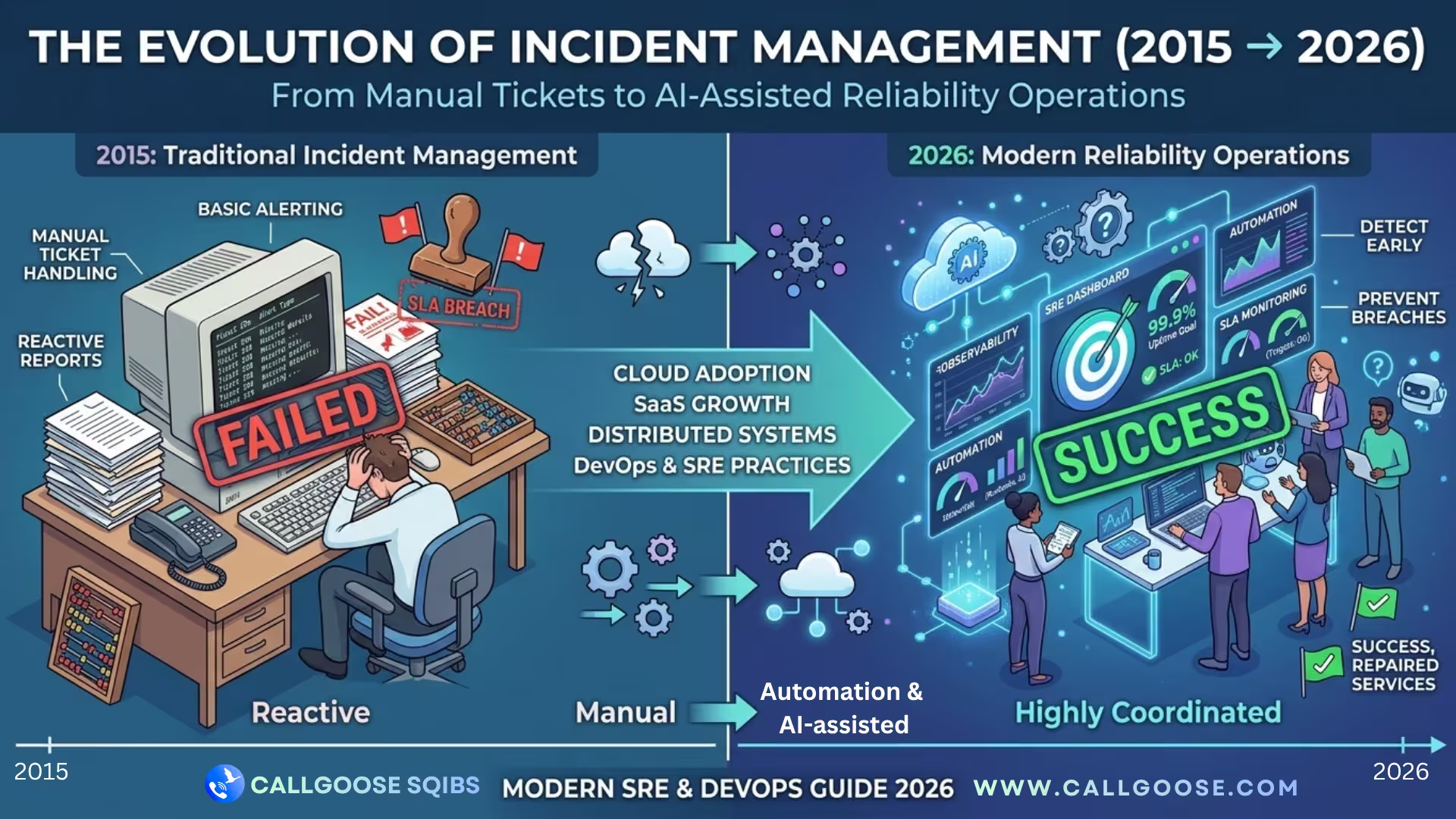
Automation can help organizations improve both response speed and response effectiveness, but only when it supports informed decision-making rather than simply accelerating actions.
This is where Callgoose SQIBS provides value. As an Incident Response Management platform, Callgoose SQIBS helps organizations engage responders quickly while maintaining the structure and visibility needed for effective incident response. Through capabilities such as automated notifications, on-call scheduling, escalation workflows, service-based routing, incident tracking, and response coordination, the platform helps ensure incidents are acknowledged promptly and routed to the appropriate teams.
At the same time, responders gain visibility into incident status, response progress, and operational context, enabling more informed decisions throughout the incident lifecycle. The objective is not simply to respond faster. It is to help organizations balance speed, coordination, communication, and situational awareness so incidents can be resolved effectively and consistently.
Automation can accelerate operational workflows, but effective response still depends on human judgment, collaboration, and a clear understanding of the broader operational impact.
Conclusion
Speed remains an important component of incident response, and organizations should continue working to reduce unnecessary delays wherever possible. However, response speed alone does not determine incident response success.
The most effective teams combine rapid action with informed decision-making, clear communication, appropriate escalation, and a thorough understanding of operational impact. By combining skilled responders, structured response processes, and platforms such as Callgoose SQIBS that support effective incident response management, organizations can improve both response efficiency and response quality.
In the end, organizations are not measured by how quickly they react to incidents they are measured by how effectively they resolve them.
🔗 Get Started with Callgoose SQIBS: Try Now
If you’re managing critical IT systems or have customer-facing platforms, Callgoose SQIBS is a game-changer! 💡 It’s designed to quickly fix issues, reduce downtime, and boost your support team’s productivity.
Callgoose SQIBS is a cutting-edge automation platform designed to elevate your organization’s resilience, reliability, and operational efficiency. With powerful On-Call scheduling, real-time Incident Management, SLA Tracker and Incident Response capabilities, it ensures your systems are always on and responsive. Whether you need Process Automation, Runbook Automation, Incident Auto-remediation, IT request automation, or Event-Driven Automation and Self-service portal, Callgoose SQIBS empowers you with comprehensive solutions. Stay connected and in control with notifications via Mobile App (Android, iPhone), Email, SMS, Phone Calls in over 30+ languages across 200+ countries, and seamless integrations with Slack & Microsoft Teams. Empower your team to Trigger, Acknowledge, Resolve Incidents and Run Automation Workflow directly from Slack & Microsoft Teams.
Check out these videos to see how it works:
• Watch our quick 30-second video : Watch Here
• What is Callgoose SQIBS? : Watch Here
• Process Automation : Watch Here
• Runbook Automation : Watch Here
• Self-Service Portal : Watch Here
• SLA Tracker : Watch Here
Additionally, here is a helpful blog post on
• why businesses choose Callgoose SQIBS: Why Business Need to Choose Callgoose SQIBS
• Transforming Business Operations with Callgoose SQIBS — Incident Management & Automation Platform
• How Callgoose SQIBS Automation Platform Enhances Efficiency
• Use Cases Industry Sector-wise
• Solutions — By Functionality
Ready to Transform Your Incident Response?
See Callgoose SQIBS in action by exploring our website visit www.callgoose.com, or book a demo to discover how Callgoose SQIBS can optimize your workflows and boost your team’s productivity.
Let’s Talk! Reach out to us today to learn more or get personalized support.
Take the next step toward seamless automation and efficiency. We’re here to assist you every step of the way.
Take Control of Incidents — Anytime, Anywhere!
Looking forward to connecting with you!

BLOG
5m Read
Enhanced IT Notifications for Global Teams Using Callgoose SQIBS Automation
20 February 2025
|
Tony Philip
Introduction In a globally distributed IT environment, ensuring that critical notifications reach the right teams at the right time is crucial for minimizing downtime and maintaining operational effic...
BLOG
5m Read

CALLGOOSE
SQIBS
Advanced Automation-first platform with effective On-Call scheduling, real-time Incident Management, Incident Response, and SLA tracking capabilities that keep your organization more resilient, reliable, and always on.
Callgoose SQIBS can integrate with any applications or tools you use, including monitoring, ticketing, ITSM, log management, error tracking, ChatOps, collaboration tools, or any custom applications.
In addition to alerting and response, Callgoose SQIBS enables Automated Incident Remediation, SLA tracking (MTTA, MTTR, uptime), and Incident Response Threshold monitoring, allowing teams to proactively detect risks, prevent SLA breaches, and execute remediation workflows in real time.
A built-in self-service portal empowers end users to handle routine requests independently, significantly reducing operational load on engineering and IT teams.
Callgoose provides enterprise-grade automation, SLA governance, and incident response capabilities at one of the most cost-effective price points in the market.
Unique Features