CALLGOOSE
CALLGOOSE
BLOG
11 March 2026 | Sophia Mark
5 Minute Read
Introduction
Modern SaaS businesses operate in a world where reliability equals reputation. Customers expect services to be available around the clock, and when problems occur, they expect them to be acknowledged and resolved immediately.
However, many organizations underestimate one critical operational risk: slow incident response.
When incidents are not acknowledged quickly or remain unresolved for long periods, the impact goes far beyond technical inconvenience. It affects revenue, customer trust, operational efficiency, and long-term brand credibility.
In this article, we examine the hidden cost of slow incident response, why MTTA and MTTR are becoming core business KPIs, and how modern incident management platforms help organizations prevent costly delays.
What Is Incident Response Time?
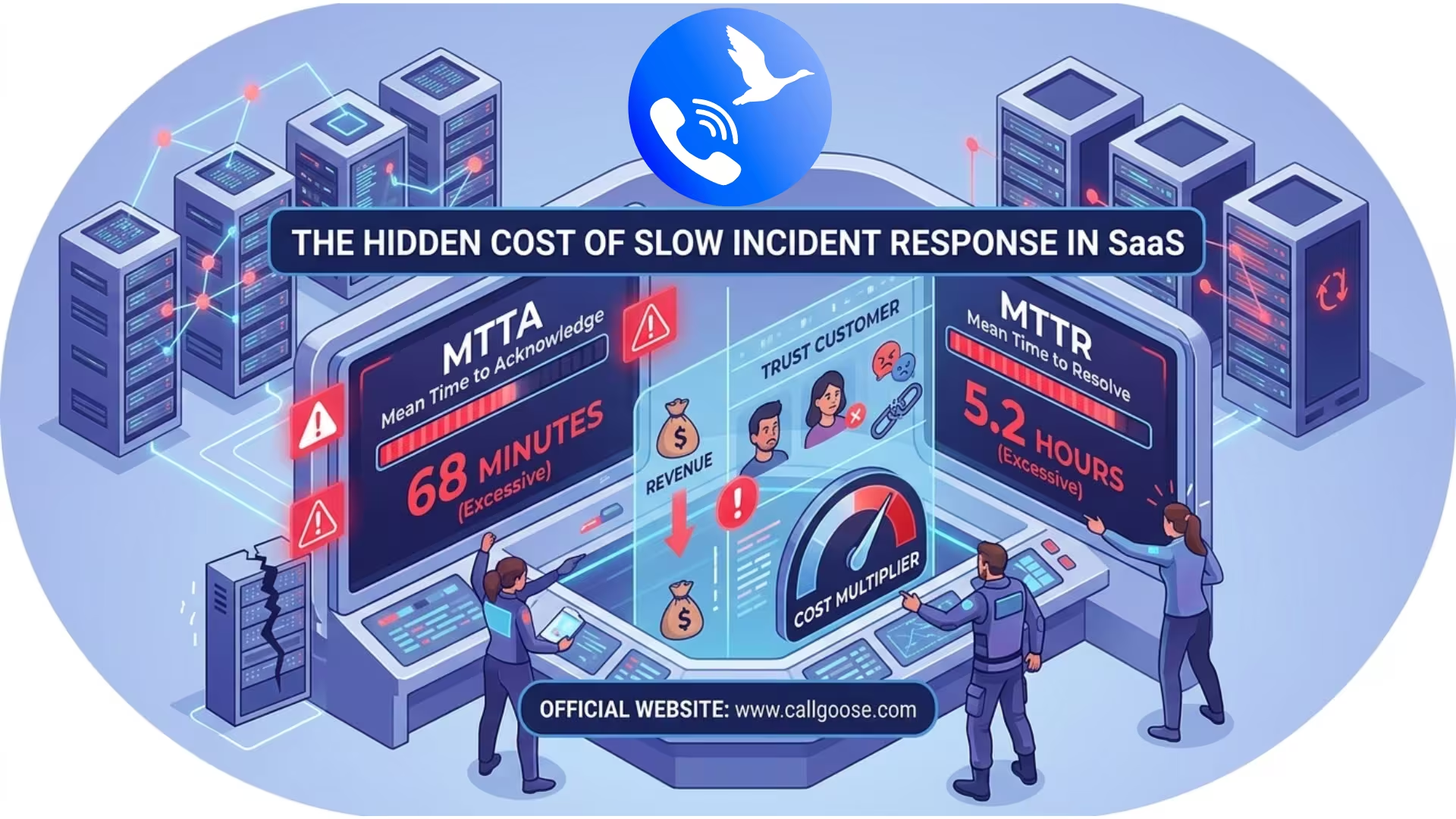
Incident response time refers to how quickly an organization reacts to operational issues that affect service availability or performance.
Two key metrics are used to measure this:
MTTA (Mean Time to Acknowledge)
MTTA measures the average time it takes for a team to acknowledge an incident after it is created.
A low MTTA indicates that incidents are being detected and acknowledged quickly.
MTTR (Mean Time to Resolve)
MTTR measures the average time required to fully resolve an incident and restore normal service.
A low MTTR indicates that teams are resolving issues efficiently.
These two metrics form the foundation of incident response performance monitoring.
For many SaaS companies, improving MTTA and MTTR has become essential for maintaining uptime commitments and protecting the customer experience.
Why Slow Incident Response Is a Serious Business Risk
A delayed response to incidents creates a ripple effect across the entire organization. The cost of slow response is rarely limited to technical downtime.
Instead, it affects multiple layers of the business.
1. Revenue Loss During Service Downtime
Every minute of downtime represents lost revenue for SaaS businesses.
If an incident is not acknowledged quickly, the service may remain degraded or unavailable while teams remain unaware of the issue.
According to research from the Uptime Institute, the financial impact of outages continues to increase each year, with many organizations reporting outage costs exceeding hundreds of thousands of dollars per incident.
Delayed incident acknowledgment can significantly extend downtime, increasing:
For SaaS platforms handling subscriptions, payments, or business automation, these interruptions directly translate to financial losses.
2. Customer Churn Caused by Poor Reliability
Customers rely on SaaS platforms to run critical operations.
When incidents take too long to acknowledge or resolve, users often assume the service provider lacks operational maturity.
Repeated incidents with slow response times can lead to:
A study from Gartner highlights that customer experience is now a major driver of retention, and service reliability is a key component of that experience.
SaaS companies that fail to respond quickly during incidents risk losing customers to competitors that demonstrate stronger operational reliability.
3. Damage to Brand Reputation
In today's connected world, service outages become visible very quickly.
Customers often report issues on:
If the organization appears slow to respond, it creates the perception that the service provider is unprepared or unresponsive.
This reputational damage can be far more costly than the outage itself.
Companies that manage incidents effectively often publish incident updates quickly, demonstrating operational control and transparency.
Fast response time helps protect brand credibility even when outages occur.
4. Increased Operational Stress for Engineering Teams
When incidents remain unnoticed or unresolved for long periods, the recovery process becomes significantly more complex.
Engineering teams may face:
Slow incident acknowledgment also increases the likelihood that issues escalate into major outages.
Instead of resolving problems early, teams end up dealing with large-scale service recovery efforts.
Improving incident response metrics such as MTTA helps prevent these escalation scenarios.
5. Breach of Service Level Agreements (SLAs)
Many SaaS companies operate under contractual Service Level Agreements (SLAs) that guarantee uptime and reliability.
Slow incident response can easily lead to:
Organizations that fail to maintain strong incident response discipline risk breaching SLA commitments with their customers.
This is why modern SaaS platforms increasingly monitor incident response metrics alongside uptime metrics.
Why MTTA and MTTR Are Now Business KPIs
Traditionally, metrics such as MTTA and MTTR were considered engineering metrics.
Today, they are increasingly viewed as business performance indicators.
Leadership teams use these metrics to evaluate:
Fast incident acknowledgment reduces downtime, while fast incident resolution restores service quickly.
Together, they form a measurable indicator of organizational responsiveness during critical events.
Companies with strong MTTA and MTTR performance typically demonstrate:
The Role of Incident Response Threshold Monitoring
Improving incident response metrics requires more than simply measuring them.
Organizations need mechanisms that actively enforce response-time expectations.
This is where Incident Response Threshold monitoring becomes essential.
Incident Response Threshold systems allow organizations to define response targets such as:
If an incident exceeds these thresholds, the system automatically triggers alerts and escalation policies.
This ensures that incidents do not remain unattended.
By enforcing response timing standards, organizations can maintain consistent operational discipline across teams.
How Modern Incident Management Platforms Improve Response Time
Modern incident management platforms combine monitoring, alerting, and response coordination into a single operational workflow.
Key capabilities include:
Automated Incident Alerts
Systems detect incidents automatically and notify the responsible teams immediately.
Escalation Policies
If an incident is not acknowledged within the defined MTTA threshold, alerts escalate to additional responders.
Retrigger Notifications
Repeated alerts ensure that incidents are not missed or ignored.
Response Performance Tracking
Incident response metrics are recorded automatically, enabling teams to measure and improve operational performance.
These capabilities help organizations maintain consistent and reliable incident response processes.
Building a Culture of Fast Incident Response
Technology alone is not enough to improve response metrics.
Organizations must also establish clear operational practices.
Best practices include:
When incident response expectations are clearly defined and enforced, teams can respond faster and more consistently.
Strengthening Reliability with Automated Incident Management
For SaaS companies operating at scale, manual incident coordination is no longer sufficient.
Platforms like Callgoose SQIBS provide integrated capabilities for:
These tools allow organizations to enforce operational discipline while maintaining full visibility into service reliability.
Callgoose SQIBS supports both SaaS and self-hosted deployments, enabling organizations to choose the deployment model that aligns with their infrastructure and compliance requirements.
Final Thoughts
Slow incident response is not just a technical inefficiency. It is a business risk that affects revenue, customer trust, and long-term growth.
As SaaS ecosystems become more complex and customer expectations continue to rise, organizations must treat incident response performance as a strategic priority.
Monitoring metrics such as MTTA and MTTR, combined with automated Incident Response Threshold enforcement, allows businesses to respond faster, reduce downtime, and maintain strong service reliability.
In the modern SaaS landscape, fast incident response is no longer optional, it is a competitive advantage.
🔗 Get Started with Callgoose SQIBS: Try Now
If you're managing critical IT systems or have customer-facing platforms, Callgoose SQIBS is a game-changer! 💡 It’s designed to quickly fix issues, reduce downtime, and boost your support team’s productivity.
Callgoose SQIBS is a cutting-edge automation platform designed to elevate your organization's resilience, reliability, and operational efficiency. With powerful On-Call scheduling, real-time Incident Management, SLA Tracker and Incident Response capabilities, it ensures your systems are always on and responsive. Whether you need Process Automation, Runbook Automation, Incident Auto-remediation, IT request automation, or Event-Driven Automation and Self-service portal, Callgoose SQIBS empowers you with comprehensive solutions. Stay connected and in control with notifications via Mobile App (Android, iPhone), Email, SMS, Phone Calls in over 30+ languages across 200+ countries, and seamless integrations with Slack & Microsoft Teams. Empower your team to Trigger, Acknowledge, Resolve Incidents and Run Automation Workflow directly from Slack & Microsoft Teams.
Check out these videos to see how it works:
• Watch our quick 30-second video : Watch Here
• What is Callgoose SQIBS? : Watch Here
• Process Automation : Watch Here
• Runbook Automation : Watch Here
• Self-Service Portal : Watch Here
• SLA Tracker : Watch Here
Additionally, here is a helpful blog post on
• why businesses choose Callgoose SQIBS: Why Business Need to Choose Callgoose SQIBS
• Transforming Business Operations with Callgoose SQIBS - Incident Management & Automation Platform
• How Callgoose SQIBS Automation Platform Enhances Efficiency
• Use Cases Industry Sector-wise
• Solutions – By Functionality
Ready to Transform Your Incident Response?
See Callgoose SQIBS in action by exploring our website visit www.callgoose.com, or book a demo to discover how Callgoose SQIBS can optimize your workflows and boost your team’s productivity.
Let’s Talk! Reach out to us today to learn more or get personalized support.
Take the next step toward seamless automation and efficiency. We’re here to assist you every step of the way.
Take Control of Incidents – Anytime, Anywhere!
Looking forward to connecting with you!
BLOG
5m Read
BLOG
5m Read

CALLGOOSE
SQIBS
Advanced Automation-first platform with effective On-Call scheduling, real-time Incident Management, Incident Response, and SLA tracking capabilities that keep your organization more resilient, reliable, and always on.
Callgoose SQIBS can integrate with any applications or tools you use, including monitoring, ticketing, ITSM, log management, error tracking, ChatOps, collaboration tools, or any custom applications.
In addition to alerting and response, Callgoose SQIBS enables Automated Incident Remediation, SLA tracking (MTTA, MTTR, uptime), and Incident Response Threshold monitoring, allowing teams to proactively detect risks, prevent SLA breaches, and execute remediation workflows in real time.
A built-in self-service portal empowers end users to handle routine requests independently, significantly reducing operational load on engineering and IT teams.
Callgoose provides enterprise-grade automation, SLA governance, and incident response capabilities at one of the most cost-effective price points in the market.
Unique Features