
CALLGOOSE
CALLGOOSE
BLOG
31 March 2026 | Sophia Mark
5 Minute Read
Introduction
Modern software systems operate in highly dynamic environments where infrastructure, applications, and services are constantly evolving. As organizations adopt microservices architectures, distributed systems, and continuous deployment pipelines, maintaining service reliability becomes significantly more challenging.
In this environment, successful DevOps teams rely on more than just tools they depend on operational discipline. Operational discipline ensures that teams follow structured processes for detecting issues, responding to incidents, maintaining service-level commitments, and continuously improving system reliability.
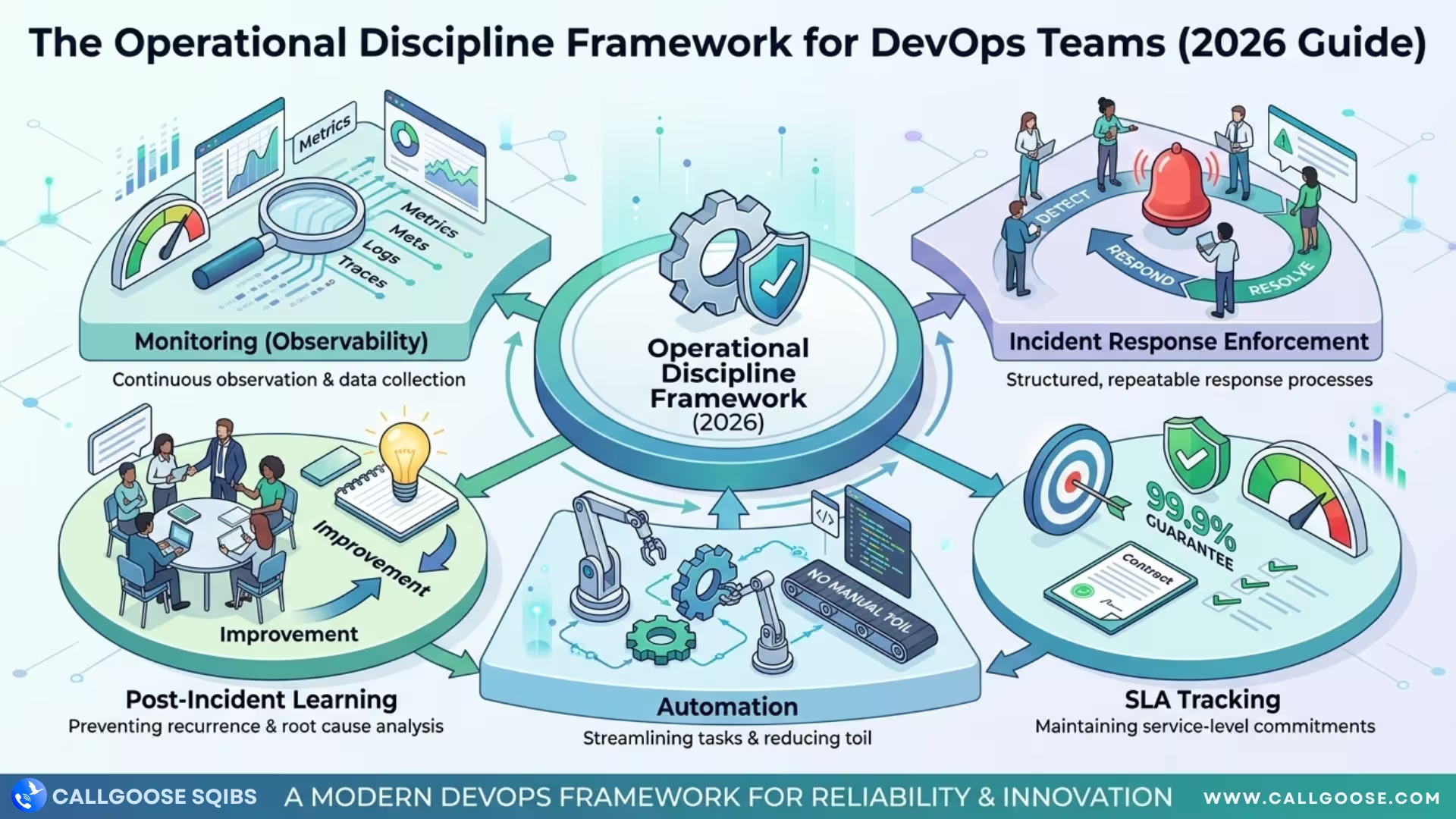
In 2026, high-performing DevOps organizations increasingly adopt a structured Operational Discipline Framework that integrates monitoring, incident response enforcement, SLA tracking, post-incident learning, and automation.
This framework helps teams maintain reliable systems while supporting rapid innovation and continuous delivery.
Why Operational Discipline Matters in Modern DevOps
DevOps enables teams to deliver software faster, but speed without discipline can introduce operational risk.
Without structured operational processes, organizations often experience:
Operational discipline provides the structure needed to maintain reliability even as systems grow more complex.
The most successful DevOps teams treat reliability as an engineering practice, not just an operational responsibility.
The Five Pillars of Operational Discipline
A practical operational discipline framework typically includes five key components:
Together, these components create a reliability-driven operational culture.
1. Monitoring: Detecting Problems Early
Monitoring is the foundation of operational discipline. Without visibility into system behavior, teams cannot detect or respond to issues effectively.
Modern monitoring systems track a wide range of operational metrics, including:
Advanced observability platforms also provide distributed tracing, log analysis, and anomaly detection.
These capabilities allow DevOps teams to identify problems before they escalate into major service disruptions.
Industry guidance from the Cloud Native Computing Foundation emphasizes the importance of comprehensive observability in cloud-native architectures.
Monitoring provides the operational awareness required to maintain service reliability.
2. Incident Response Enforcement
Detecting incidents is only the first step. Teams must also respond quickly and consistently when incidents occur.
Incident response enforcement ensures that organizations maintain structured procedures for handling production issues.
Key components of effective incident response include:
Operational frameworks such as those described in the Site Reliability Engineering highlight the importance of structured incident management practices.
One important mechanism used in modern incident response systems is incident response thresholds, which monitor operational metrics such as:
If these thresholds are exceeded, automated alerts ensure that incidents receive additional attention.
Enforcing these response standards helps organizations reduce incident duration and maintain operational consistency.
3. SLA Tracking: Protecting Service Commitments
While incident response focuses on operational recovery, SLA tracking focuses on customer commitments.
Service Level Agreements define the reliability expectations between service providers and customers.
These commitments often include:
Without structured SLA monitoring, organizations may struggle to detect when reliability commitments are at risk.
Modern SLA tracking systems continuously monitor:
When SLA risk thresholds are reached, early alerts allow teams to take corrective action before a breach occurs.
This proactive approach helps organizations maintain contractual reliability commitments.
4. Postmortems: Learning from Incidents
Even the most reliable systems experience occasional failures. What distinguishes mature DevOps teams is how they respond after incidents are resolved.
Post-incident reviews, commonly known as postmortems, are structured analyses conducted after major incidents.
The purpose of postmortems is to identify:
Leading reliability teams adopt blameless postmortem practices, which focus on learning rather than assigning fault.
These reviews enable organizations to continuously improve their operational processes and reduce the likelihood of recurring incidents.
5. Automation: Scaling Operational Efficiency
As infrastructure grows, manual operations become increasingly difficult to manage.
Automation plays a critical role in maintaining operational discipline at scale.
Automation can support many operational activities, including:
Automation reduces human error, accelerates response times, and allows operations teams to focus on complex problem-solving rather than repetitive tasks.
Modern DevOps environments rely heavily on automation to maintain reliability across large-scale distributed systems.
Integrating the Framework into DevOps Operations
The five pillars of operational discipline are most effective when integrated into a unified operational platform.
Instead of managing monitoring, incident management, and SLA tracking through separate tools, many organizations now adopt integrated reliability platforms that bring these capabilities together.
This approach improves:
It also reduces the complexity of managing multiple independent systems.
Enabling Operational Discipline with Callgoose SQIBS
Platforms such as Callgoose SQIBS are designed to support the operational discipline framework used by modern DevOps teams.
The platform integrates multiple reliability management capabilities, including:
By combining these capabilities into a single reliability platform, organizations gain full visibility into both operational performance and service reliability.
Callgoose SQIBS supports both SaaS deployment and self-hosted environments, allowing teams to adopt the platform according to their infrastructure and security requirements.
This flexibility enables organizations to implement reliability management practices that align with their operational and compliance needs.
Final Thoughts
DevOps success depends not only on speed and innovation but also on maintaining strong operational discipline.
As systems grow more complex, organizations must adopt structured frameworks that support reliable service delivery.
The Operational Discipline Framework for DevOps teams includes five essential pillars:
Together, these practices create a resilient operational culture that supports both rapid development and reliable service delivery.
In 2026, organizations that adopt structured operational discipline frameworks will be better positioned to maintain high availability, strong reliability, and consistent customer trust in modern SaaS environments.
🔗 Get Started with Callgoose SQIBS: Try Now
If you're managing critical IT systems or have customer-facing platforms, Callgoose SQIBS is a game-changer! 💡 It’s designed to quickly fix issues, reduce downtime, and boost your support team’s productivity.
Callgoose SQIBS is a cutting-edge automation platform designed to elevate your organization's resilience, reliability, and operational efficiency. With powerful On-Call scheduling, real-time Incident Management, SLA Tracker and Incident Response capabilities, it ensures your systems are always on and responsive. Whether you need Process Automation, Runbook Automation, Incident Auto-remediation, IT request automation, or Event-Driven Automation and Self-service portal, Callgoose SQIBS empowers you with comprehensive solutions. Stay connected and in control with notifications via Mobile App (Android, iPhone), Email, SMS, Phone Calls in over 30+ languages across 200+ countries, and seamless integrations with Slack & Microsoft Teams. Empower your team to Trigger, Acknowledge, Resolve Incidents and Run Automation Workflow directly from Slack & Microsoft Teams.
Check out these videos to see how it works:
• Watch our quick 30-second video : Watch Here
• What is Callgoose SQIBS? : Watch Here
• Process Automation : Watch Here
• Runbook Automation : Watch Here
• Self-Service Portal : Watch Here
• SLA Tracker : Watch Here
Additionally, here is a helpful blog post on
• why businesses choose Callgoose SQIBS: Why Business Need to Choose Callgoose SQIBS
• Transforming Business Operations with Callgoose SQIBS - Incident Management & Automation Platform
• How Callgoose SQIBS Automation Platform Enhances Efficiency
• Use Cases Industry Sector-wise
• Solutions – By Functionality
Ready to Transform Your Incident Response?
See Callgoose SQIBS in action by exploring our website visit www.callgoose.com, or book a demo to discover how Callgoose SQIBS can optimize your workflows and boost your team’s productivity.
Let’s Talk! Reach out to us today to learn more or get personalized support.
Take the next step toward seamless automation and efficiency. We’re here to assist you every step of the way.
Take Control of Incidents – Anytime, Anywhere!
Looking forward to connecting with you!

BLOG
5m Read

CALLGOOSE
SQIBS
Advanced Automation-first platform with effective On-Call scheduling, real-time Incident Management, Incident Response, and SLA tracking capabilities that keep your organization more resilient, reliable, and always on.
Callgoose SQIBS can integrate with any applications or tools you use, including monitoring, ticketing, ITSM, log management, error tracking, ChatOps, collaboration tools, or any custom applications.
In addition to alerting and response, Callgoose SQIBS enables Automated Incident Remediation, SLA tracking (MTTA, MTTR, uptime), and Incident Response Threshold monitoring, allowing teams to proactively detect risks, prevent SLA breaches, and execute remediation workflows in real time.
A built-in self-service portal empowers end users to handle routine requests independently, significantly reducing operational load on engineering and IT teams.
Callgoose provides enterprise-grade automation, SLA governance, and incident response capabilities at one of the most cost-effective price points in the market.
Unique Features
