
CALLGOOSE
CALLGOOSE
BLOG
24 August 2026 | Sophia Mark
5 Minute Read
Introduction
In IT operations, DevOps, Site Reliability Engineering (SRE), and enterprise support environments, the terms incident management and incident response are often used interchangeably. While the two are closely related, they are not the same thing.
Understanding the difference is important because organizations that treat incident management and incident response as a single discipline often struggle with inconsistent processes, communication gaps, delayed escalations, and longer recovery times.
Incident response focuses on addressing an active issue, while incident management encompasses the broader framework that governs how incidents are tracked, coordinated, communicated, and continuously improved. Both are essential for maintaining operational reliability, but each serves a different purpose.

What Is Incident Response?
Incident response refers to the actions taken after an incident has been detected.
Its primary objective is to minimize impact, restore services, and return systems to normal operation as quickly as possible. During an incident, responders investigate the issue, identify the cause, implement mitigation steps, and work toward resolution.
A typical incident response process may include:
Incident response is operational and time-sensitive. Teams focus on immediate actions that reduce downtime and limit business disruption.
For example, if a payment processing service becomes unavailable, responders may work to identify the root cause, restart affected services, reroute traffic, or apply temporary fixes to restore functionality.
The goal is simple: resolve the incident as efficiently as possible.
What Is Incident Management?
Incident management is the broader discipline that oversees the entire incident lifecycle.
Rather than focusing solely on technical recovery, incident management provides the structure, processes, communication, accountability, and governance needed to manage incidents consistently across an organization.
Incident management typically includes:
While incident response focuses on solving the immediate problem, incident management ensures that the right people are involved, the correct processes are followed, and lessons are captured for future improvement.
In other words, incident response happens within an incident management framework.
Key Differences Between Incident Management and Incident Response
Although they work together, the two disciplines differ in several important ways.
Scope
Incident response focuses on resolving a specific incident.
Incident management focuses on governing how all incidents are handled across the organization.
Timeline
Incident response primarily occurs during an active incident.
Incident management begins before an incident occurs and continues after it has been resolved through reporting, analysis, and process improvements.
Objectives
Incident response aims to restore services quickly.
Incident management aims to ensure incidents are handled consistently, efficiently, and transparently.
Participants
Incident response is usually driven by technical responders, engineers, operations teams, and subject matter experts.
Incident management may involve engineering leaders, service owners, management teams, support personnel, business stakeholders, and communications teams.
Success Metrics
Incident response is often measured by restoration speed and technical outcomes.
Incident management is evaluated through broader operational metrics such as response consistency, escalation effectiveness, communication quality, and continuous improvement efforts.
Why Organizations Need Both
Some organizations invest heavily in incident response capabilities but neglect incident management processes. Others establish extensive procedures but lack effective response mechanisms.
Neither approach is sufficient on its own.
Strong incident response without incident management can create confusion during major incidents. Teams may not know who owns a service, who should be notified, or how escalations should be handled.
Conversely, strong incident management without effective response capabilities can lead to excessive coordination without meaningful progress toward resolution.
Organizations achieve the best outcomes when both disciplines work together.
Incident response provides the action.
Incident management provides the structure.
Common Challenges
Many organizations encounter similar challenges when building incident programs.
Treating Incident Management and Incident Response as the Same Thing
When these disciplines are viewed as identical, organizations often focus exclusively on technical recovery while overlooking communication, coordination, and process improvement.
Lack of Clear Ownership
Unclear service ownership can delay investigations and create confusion during escalations.
Inconsistent Communication
Without defined communication procedures, stakeholders may receive incomplete or delayed updates during critical incidents.
Limited Visibility
Teams often struggle when incident information is scattered across multiple systems, communication channels, and operational tools.
Failure to Learn From Incidents
Organizations that do not conduct reviews or analyze recurring patterns miss valuable opportunities to improve reliability.
Building a More Effective Incident Program
Successful organizations view incident management and incident response as complementary capabilities.
A mature incident program typically includes:
These practices help teams respond faster while ensuring incidents are managed consistently across the organization.
The Role of Modern Incident Management Platforms
As environments become more complex, organizations often rely on dedicated incident management platforms to support both response and management activities.
While incident management covers the broader processes, governance, communication, and continuous improvement associated with handling incidents, incident response requires teams to engage the right responders quickly, coordinate actions effectively, and restore services with minimal disruption.
This is where platforms such as Callgoose SQIBS play an important role. Callgoose SQIBS specializes in Incident Response Management, helping organizations strengthen one of the most critical components of the overall incident management lifecycle. Through capabilities such as on-call scheduling, automated escalations, multi-channel notifications, response coordination, service-based routing, and incident tracking, the platform helps ensure incidents reach the right teams at the right time and receive appropriate attention throughout the response process.
By improving responder engagement and response coordination, organizations can reduce delays, improve consistency, and strengthen operational resilience while supporting their broader incident management objectives.
The objective is not simply to resolve incidents faster, but to build a repeatable and scalable process that supports operational resilience.
Conclusion
Incident response and incident management are closely connected, but they serve different purposes.
Incident response focuses on the immediate actions required to restore services during an active incident. Incident management provides the processes, coordination, visibility, and governance that ensure incidents are handled consistently from detection through resolution and review.
Organizations that understand this distinction are better positioned to improve operational reliability, reduce downtime, and build more effective incident programs.
The most successful teams do not choose between incident management and incident response they invest in both.
🔗 Get Started with Callgoose SQIBS: Try Now
If you’re managing critical IT systems or have customer-facing platforms, Callgoose SQIBS is a game-changer! 💡 It’s designed to quickly fix issues, reduce downtime, and boost your support team’s productivity.
Callgoose SQIBS is a cutting-edge automation platform designed to elevate your organization’s resilience, reliability, and operational efficiency. With powerful On-Call scheduling, real-time Incident Management, SLA Tracker and Incident Response capabilities, it ensures your systems are always on and responsive. Whether you need Process Automation, Runbook Automation, Incident Auto-remediation, IT request automation, or Event-Driven Automation and Self-service portal, Callgoose SQIBS empowers you with comprehensive solutions. Stay connected and in control with notifications via Mobile App (Android, iPhone), Email, SMS, Phone Calls in over 30+ languages across 200+ countries, and seamless integrations with Slack & Microsoft Teams. Empower your team to Trigger, Acknowledge, Resolve Incidents and Run Automation Workflow directly from Slack & Microsoft Teams.
Check out these videos to see how it works:
• Watch our quick 30-second video : Watch Here
• What is Callgoose SQIBS? : Watch Here
• Process Automation : Watch Here
• Runbook Automation : Watch Here
• Self-Service Portal : Watch Here
• SLA Tracker : Watch Here
Additionally, here is a helpful blog post on
• why businesses choose Callgoose SQIBS: Why Business Need to Choose Callgoose SQIBS
• Transforming Business Operations with Callgoose SQIBS — Incident Management & Automation Platform
• How Callgoose SQIBS Automation Platform Enhances Efficiency
• Use Cases Industry Sector-wise
• Solutions — By Functionality
Ready to Transform Your Incident Response?
See Callgoose SQIBS in action by exploring our website visit www.callgoose.com, or book a demo to discover how Callgoose SQIBS can optimize your workflows and boost your team’s productivity.
Let’s Talk! Reach out to us today to learn more or get personalized support.
Take the next step toward seamless automation and efficiency. We’re here to assist you every step of the way.
Take Control of Incidents — Anytime, Anywhere!
Looking forward to connecting with you!
BLOG
5m Read
BLOG
5m Read
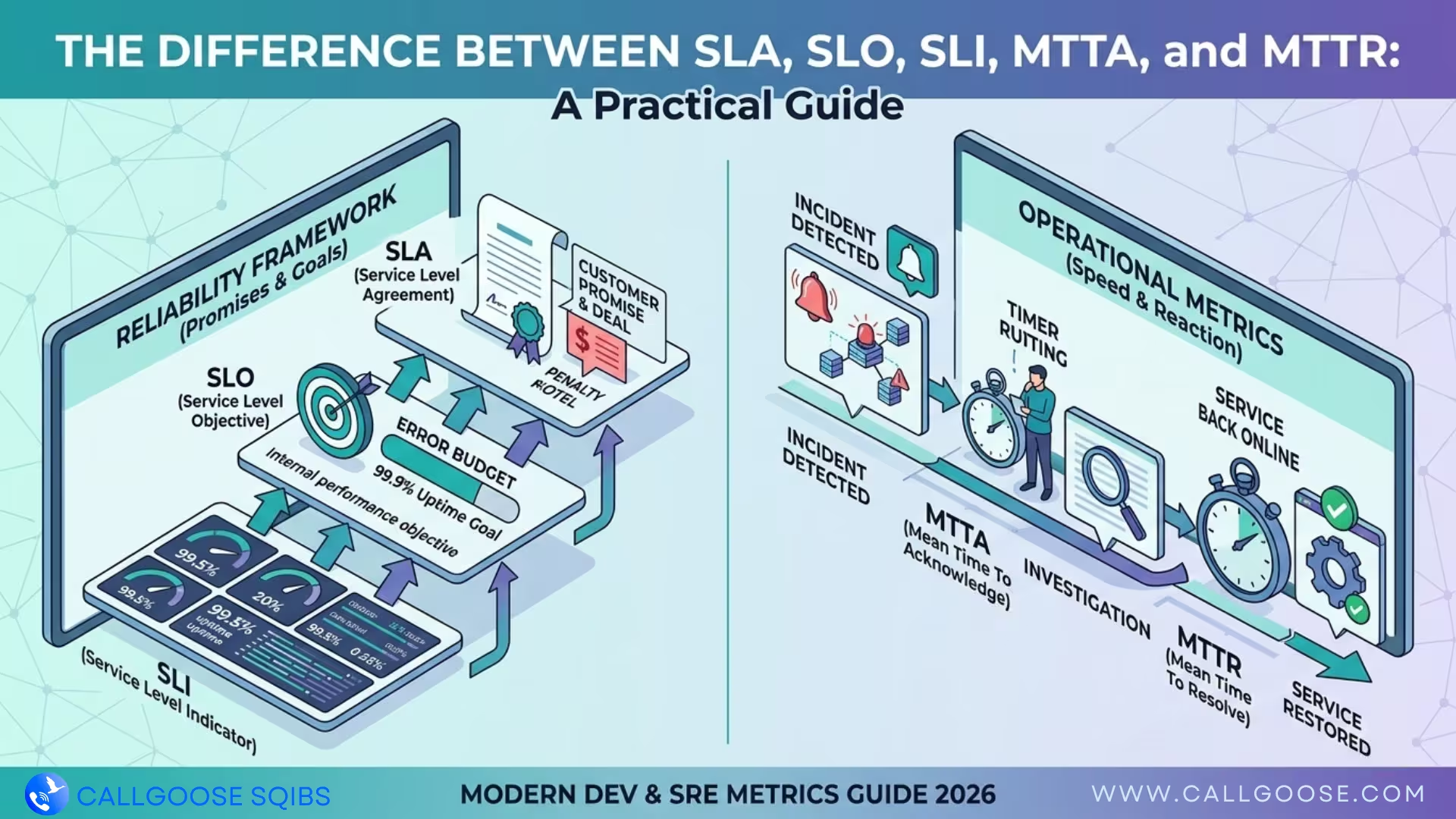
The Difference Between SLA, SLO, SLI, MTTA, and MTTR: A Practical Guide for DevOps and SRE Teams in 2026
13 March 2026
|
Sophia Mark
Introduction Modern SaaS platforms operate in highly distributed environments where reliability is critical. DevOps teams and Site Reliability Engineers (SREs) must continuously monitor system perform...

CALLGOOSE
SQIBS
Advanced Automation-first platform with effective On-Call scheduling, real-time Incident Management, Incident Response, and SLA tracking capabilities that keep your organization more resilient, reliable, and always on.
Callgoose SQIBS can integrate with any applications or tools you use, including monitoring, ticketing, ITSM, log management, error tracking, ChatOps, collaboration tools, or any custom applications.
In addition to alerting and response, Callgoose SQIBS enables Automated Incident Remediation, SLA tracking (MTTA, MTTR, uptime), and Incident Response Threshold monitoring, allowing teams to proactively detect risks, prevent SLA breaches, and execute remediation workflows in real time.
A built-in self-service portal empowers end users to handle routine requests independently, significantly reducing operational load on engineering and IT teams.
Callgoose provides enterprise-grade automation, SLA governance, and incident response capabilities at one of the most cost-effective price points in the market.
Unique Features